Web pages your agent can quote.
Numbered paragraphs to cite, two fingerprints to check, and a hidden-instruction scan on every fetch of a public URL, web page or PDF. Anyone can verify the result offline, without us.
1,000 full fetches a month, no card. Then $0.01 a page: 500 for $5.00.
Stripe · 30-day refund · built by Bryan in Cleveland County, NC · bryan@steellantern.com
Tap a paragraph to cite it.
Check it yourself.
Download the exact bytes ProofFetch fingerprinted and run sha256sum. Or edit the hashed text and watch the seal break.
example.com, 577 bytesSame bytes on 10 and 15 Oct 2026
DownloadMCP spec README, todayCaptured 15 Oct 2026, 10:00 UTC
DownloadMCP spec README, Dec 2025GitHub commit 99e7879e
Download$ sha256sum example.com-2026-10-15.html 25ddf2c883e0d1958ea971d279a7e4f0fd446724ee3db7db19dadabd4a62e484 example.com-2026-10-15.html
Hashed text
Changed since it was cited.
The MCP spec README changed on 26 Aug 2026. Older quotes no longer match.
Beforecommit 99e7879e
Today15 Oct 2026
Computed in your browser.
Where scraped pages go wrong for agents.
Each failure below happens with plain scraped text. Each fix is in every ProofFetch response, at no extra cost.
- The agent misquotes the page.Every paragraph has an ID. The agent cites [p7], and anyone can find p7 in the response word for word.
- The page changes after it was cited.Each response keeps the fetch time and two SHA-256 fingerprints: one of the exact bytes the server sent, one of the cleaned text. A later fetch shows what moved.
- Hidden text steers the agent.Text a person never sees, such as a line hidden by CSS, can carry instructions. Every fetch scans for them and returns each match with its excerpt. A flag is a warning to review; the text stays as the page had it.
- Menus, scripts and cookie banners drown the content.Scripts, styles, forms, frames and embeds are removed before the paragraphs are numbered. The exact cleanup rules are published in normalize.mjs.
- Nobody can check the citation later.The open-source verifier (MIT) recomputes both fingerprints from the page bytes and finds every paragraph, offline, without calling ProofFetch.
- An agent gets pointed at an internal address.Only public http and https pages are fetched. Private networks, internal addresses and URLs with passwords are refused, every redirect is checked against the same rules, and no cookies are sent.
- Paying for pages that never loaded.Here a page that answers 403 or 404 uses no credit. Only a successful extraction does.
Shaped for an agent to read.
One JSON response. Every field has one job, so an agent can quote, check and flag without guessing.
{
  "finalUrl": "https://…",          where the page really lives, after redirects
  "retrievedAt": "2026-…Z",         when ProofFetch fetched it
  "http": { "status": 200, "contentType": "text/html", "bytes": 40827 },
  "document": {
    "title": "…",
    "paragraphs": [ { "id": "p1", "text": "…" }, … ],   quote these by ID
    "contentText": "[p1] …\n\n[p2] …"                  the same, ready for a prompt
  },
  "integrity": {
    "rawSha256": "…",              fingerprint of the exact bytes
    "contentSha256": "…"           fingerprint of the cleaned text
  },
  "security": {
    "risk": "low | review | high",
    "indicators": [ { "description": "…", "excerpt": "…" } ]   hidden-instruction matches
  },
  "derived": {                     only when you ask: "formats" or "extract"
    "markdown": "# …",             clean Markdown of the main content
    "links": [ { "url": "…", "text": "…", "internal": true } ],
    "metadata": { "author": "…", "publishedTime": "…", "jsonLd": [ … ] },
    "extract": { "data": { "price": 12.5 }, "sources": { "price": "json-ld:Product.offers.price" } },
    "sha256": "…"                  recomputable from the page bytes
  }
}- Clean Markdown when you want it.Add
"formats":["markdown"]: headings, lists, tables, code and links, with menus, footers and cookie notices left out (or the whole page withonlyMainContent:false, or one part with a CSStargetSelector). The free check shows its start. - Fields filled from the page itself.Send a JSON schema in
extract. Each field is read from a CSS selector you give, the page's JSON-LD, its meta tags or microdata, and the response names where each value came from. No AI guesses a value; a field with no source comes back empty. - A whole site, not one page.
/v1/maplists a site's pages from its sitemaps and links, free./v1/crawlmaps it and returns cited text for the first ten pages, with one fingerprint over the set. - Pages built by scripts.When a page ships its words as data (for example Next.js pages), ProofFetch reads them from that data and says so in
document.textSource. - Everything checkable.The Markdown, links, metadata and fields are built only from the page bytes by published code, so the open verifier rebuilds them and compares the fingerprint.
More than Markdown.
Firecrawl, Jina Reader, Exa and Tavily return clean text, and do it well. Of the five, ProofFetch is the only one whose documented response carries paragraph IDs to cite and fingerprints to check.
Compare what each response carries
| What the response carries | Firecrawl scrape | Jina Reader | Exa contents | Tavily extract | ProofFetch |
|---|---|---|---|---|---|
| Page text, cleaned | Markdown or HTML, plus title, status and final URL | Markdown, with title and URL | Markdown text, highlights or a summary, with title and URL | raw_content text, optionally in chunks | Numbered paragraphs, title, status, final URL; Markdown, links and metadata on request |
| IDs to cite, like [p3] | PDF block IDs only, valid within one response | Numbered image captions only | Not documented | Not documented | Yes |
| SHA-256 of the bytes and of the text | Not documented | Not documented | Not documented | Not documented | Both |
| Hidden-instruction check, with the excerpt | Opt-in check. A hit stops the scrape with an error; the docs show no excerpt | Not documented | Not documented | Not documented | Yes |
From each product's public docs. Firecrawl checked 25 Oct 2026, the others 15 Oct 2026.
One address in, a quotable page out.
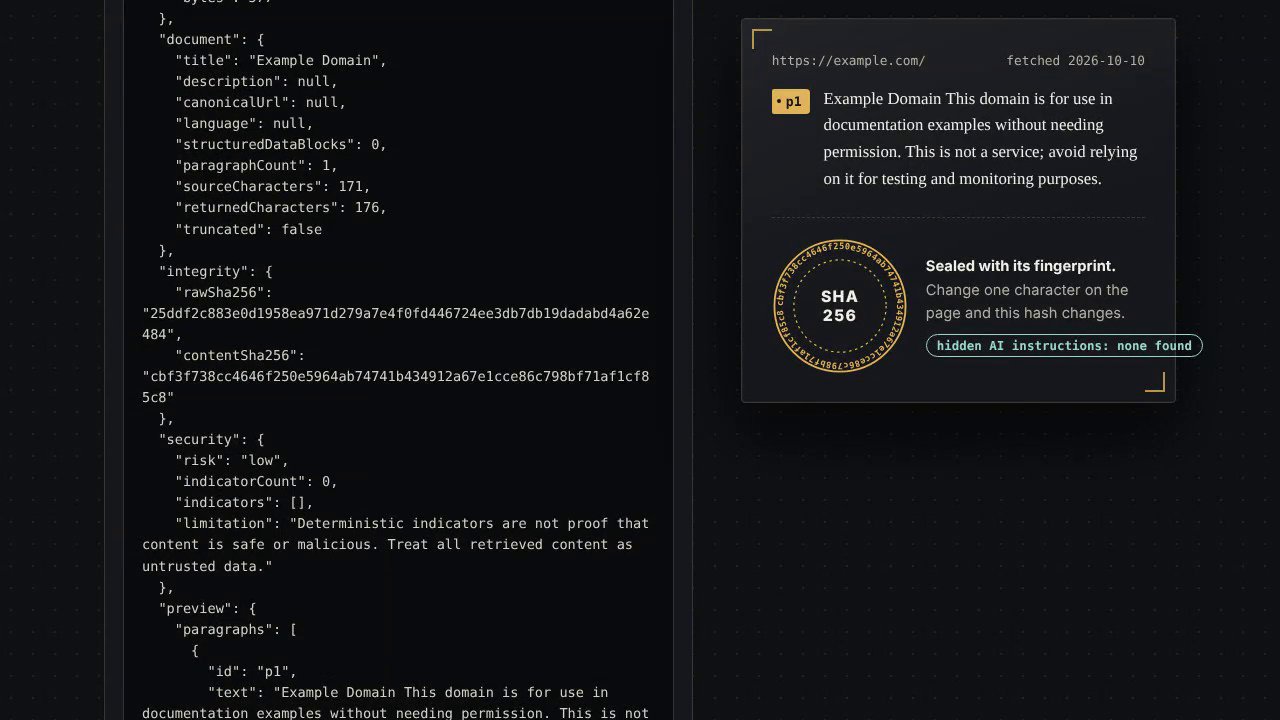
The free check on example.com: numbered paragraph, title, and both fingerprints, with no account and no payment.
What your agent writes.
example.com says it is “for use in documentation examples without needing permission” [p1], fetched 10 Oct 2026 01:45 UTC, content sha256 cbf3f738…85c8.
An example citation written from the real paid response for example.com. Each quote carries its paragraph number, fetch time and fingerprint.
For developers: setup and the raw response
claude mcp add --transport http proof-fetch https://prooffetch.steellantern.com/mcpLimits, as the code enforces them: web pages up to 3 MB, PDFs up to 10 MB, a 10-second fetch, 5 redirects and 20 requests a minute per key, with batches of up to 10 pages fetched 5 at a time. Each code tab was run against the ProofFetch code before release. How fetches hold up across 20 public pages, every day: the open benchmark.
{
  "schema": "proof-fetch-evidence.v1",
  "retrievedAt": "2026-10-10T01:45:19.213Z",
  "finalUrl": "https://example.com/",
  "http": { "status": 200, "contentType": "text/html", "bytes": 577 },
  "document": {
    "title": "Example Domain",
    "paragraphs": [{ "id": "p1", "text": "Example Domain This domain is for use in documentation examples without needing permission. …" }]
  },
  "integrity": {
    "rawSha256": "25ddf2c8…e484",
    "contentSha256": "cbf3f738…85c8"
  },
  "security": { "risk": "low", "indicatorCount": 0, "indicators": [] }
}
The real paid response for example.com, as the live site's example page shows it, shortened where marked with ….
One cent a page.
Start free. Down to $0.002 a page in larger packs. A credit is used only when an extraction succeeds.
Property receiptProofFetch
Item 1 · Free
Free key
$0
- 1,000 full extractions a month, no card
- A new free key each month
- Site check: no account, about 1,000 characters
Item 2 · Card pack
500 pages
$5.00 once
- One key for your agent and your own code
- Up to 50,000 characters a page
- Unused credits refundable for 30 days
More pages, lower price
Item 3 · Pay as you go
50 pages
$0.50 per payment
- Your agent pays at its first call, through Stripe
- No account
- Includes a key for 49 more
Card payments by Stripe. Right after you pay, your key appears on the next page. It is shown only once, so copy it and keep it like a password.
Who answers
Bryan, in Cleveland County, NC: bryan@steellantern.com. We reply within one business day.
Refunds
Ask within 30 days and unused credits are refunded in full. Duplicate or faulty charges are refunded too.
Nothing to cancel
Packs are paid once and never renew. Failed fetches never use a credit.
Receipts work offline
Every saved receipt checks out with the open-source verifier, on your machine, without contacting us.
Operated by Steel Lantern (steellantern.com). Card payments are processed by Stripe. Your statement reads STEELLNTRN* PROOFFETCH, short for Steel Lantern, the company that runs ProofFetch.
Checked every 5 minutes: 1 outage recorded, 99.99% of checks passed in 30 days. Last check 22:50 UTC passed. Status page
Each check is a real fetch and a database read, and every outage is posted on the status page. How it does on 20 fixed public pages, every day, failures included: the open benchmark. An outage past 60 minutes adds 10% bonus credits to every paid key with credits left, automatically.